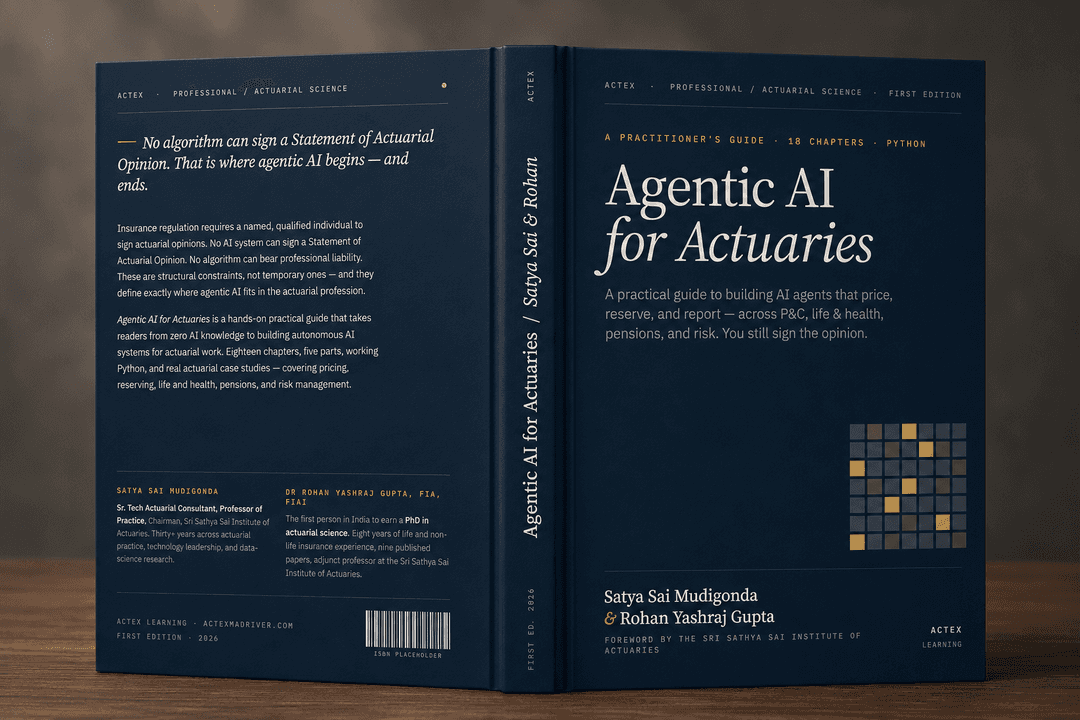
Agentic AI for Actuaries
ACTEX · First Edition · 2026
A Practitioner’s Guide · 18 Chapters · Python

Agentic AI
for Actuaries

A practical guide to building AI agents that price, reserve, and report — across P&C, life & health, pensions, and risk. You still sign the opinion.

Available later this year · Free from ACTEX

In collaboration with the Sri Sathya Sai Institute of Actuaries

Agentic AI for Actuaries — hardcover, front and back

Satya Sai Mudigonda & Rohan Yashraj Gupta · ACTEX Learning · First Edition 2026

No algorithm can sign a Statement of Actuarial Opinion. That is where agentic AI begins — and ends.
From the back cover
What’s inside

Eighteen chapters, five parts, working Python.

From AI foundations to autonomous actuarial systems: the book takes a reader with no prior AI exposure to building, deploying, and governing agentic systems for actuarial work — with real case studies across pricing, reserving, life & health, pensions, and risk.

0
Chapters

Each opens with a vignette grounding the concept in a concrete actuarial situation.

0
Parts

Foundations, LLMs, agentic architecture, actuarial practice, production & governance.

0
Practice domains

Pricing & underwriting, reserving & claims, life & pensions, risk & compliance.

0
Chapters with code

Runnable Python for every listing in Parts III–V, from your first agent to governance dashboards.

Sample · Chapter 1

The AI Landscape

What actuaries need to know

It is the first Monday of January, and a pricing actuary at a mid-size composite insurer sits down to renew a commercial property portfolio of 340 accounts. By Friday, working in the traditional way, she has a preliminary indication for sixty of them. Down the corridor, a colleague using AI-assisted extraction and first-pass analysis has the full portfolio ready for peer review by Tuesday afternoon. The difference is not talent. Both hold the same fellowship qualification. The difference is the system.

Artificial intelligence is not one technology. It is a family of techniques, with different histories, different assumptions, and very different reliability profiles. For an actuary deciding what to adopt and what to defer, the first task is to learn the taxonomy. A pricing actuary using a generalised linear model is using a form of machine learning, even if the textbook calls it statistical regression. A claims handler triaging photographs of vehicle damage is using a convolutional neural network. A reserving actuary asking a chatbot to draft commentary on loss development is using a large language model. These are different tools, with different failure modes.

No AI system can sign a Statement of Actuarial Opinion. No algorithm can bear professional liability. No model can be called before a regulatory tribunal to explain its reasoning under oath. These are structural constraints, not temporary ones. They define a permanent boundary between what AI can do — process data, run models, draft reports — and what actuaries must do — exercise judgment, bear accountability, maintain professional standards.

Chapter 1 continues in the full edition

Companion code

Every listing, runnable.

An open repository carries working code for every listing in Parts III–V — your first agent in Chapter 9 through governance dashboards in Chapter 17. All datasets are synthetic; Meridian Re, the reinsurer the case studies follow, is a fictional composite. Every example runs on a free-tier model key.

View the code on GitHub
agentic-ai-for-actuaries-code/
ch09_agentic_foundations — your first agent
ch10_tool_use — mortality lookup, premium agent
ch11_multi_agent_workflows — reserving review
ch12_memory — persistent + vector memory
ch13_underwriting_agent — COPE extraction
ch14_reserving_reflexion — Cape Cod, reflexion
ch15_pension_pipeline — DB funding valuation
ch16_regulatory_capital — ORSA drafting
ch17_governance_monitoring — monitoring dashboard
The difference is not talent. Both hold the same fellowship qualification. The difference is the system.
Chapter 1 · The AI Landscape
The authors
Satya Sai Mudigonda

Satya Sai Mudigonda

CPCU · PMP · AIAI

Sr. Tech Actuarial Consultant and Professor of Practice; Chairman of the Sri Sathya Sai Institute of Actuaries. Thirty-plus years across actuarial practice, technology leadership, and data-science research.

Dr Rohan Yashraj Gupta

Dr Rohan Yashraj Gupta

PhD · FIA · FIAI

The first person in India to earn a PhD in actuarial science. Eight years of life and non-life insurance experience, nine published papers, and adjunct professor at the Sri Sathya Sai Institute of Actuaries.

Foreword by the Sri Sathya Sai Institute of Actuaries